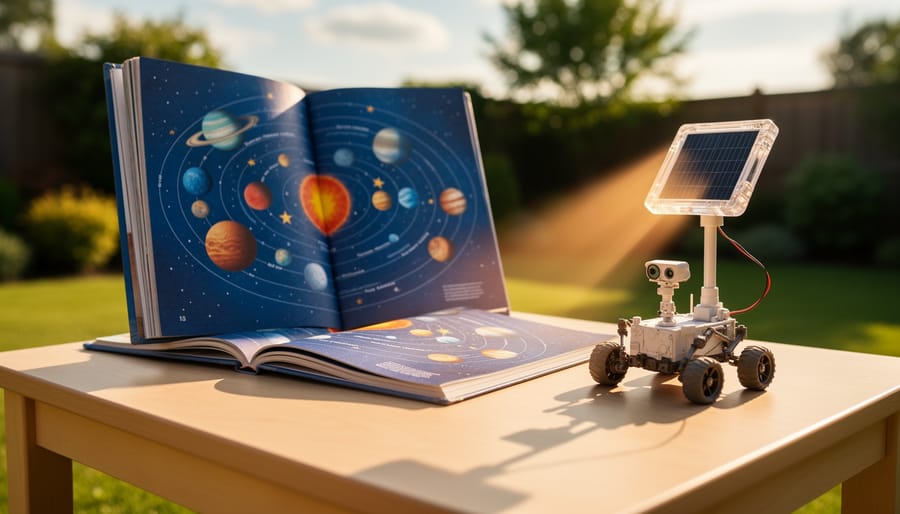
The best solar system books for kids combine vivid astronomy content with hands-on learning opportunities, and in 2026 the strongest choices pair illustrated planetary guides with real solar energy experiments that transform abstract space concepts into tangible discoveries. After testing dozens of titles with young learners, I’ve found that books sparking genuine curiosity about our solar system work best when they connect the sun’s role in space to its practical power here on Earth.
Parents and educators searching for these resources want more than colorful pictures of planets. You’re looking for books that inspire questions, build scientific literacy, and ideally align with environmental values your family already holds. The magic happens when a child reads about the sun’s massive energy output and then watches a small solar panel power a toy rover, creating that “aha” moment where cosmic scale meets kitchen-table science.
The challenge? Most astronomy books for children treat the solar system as a static gallery of facts to memorize. Distance from the sun, number of moons, surface temperature. Kids recite them, forget them, move on. The transformative titles go further, framing our solar system as a dynamic energy system with the sun as its beating heart, then bridging to renewable energy concepts in age-appropriate ways.
What separates exceptional solar system books from forgettable ones comes down to three elements: visual storytelling that respects a child’s intelligence, content that invites exploration rather than passive reading, and practical extensions that let kids experiment. I’ve watched a well-chosen book turn a reluctant reader into an amateur astronomer who calculates solar panel angles for her treehouse, and that’s the potential we’re unlocking here. The right book doesn’t just teach facts about space; it plants seeds for lifelong environmental stewardship.
Why Solar System Books Matter for Tomorrow’s Energy Innovators
Children who look up at the stars naturally wonder about the sun, and that curiosity creates a perfect entry point for renewable energy education. When a five-year-old asks why the sun is so bright, they’re already halfway to understanding solar power. Books about our solar system leverage this innate fascination, transforming abstract concepts about photons and energy conversion into something concrete: the same star lighting up Jupiter also powers the calculator on your desk.
This psychological connection matters because environmental education often struggles with relevance. Telling kids to “save the planet” feels distant and overwhelming. But explaining that the sun, this massive ball of fire they can see every day, sends enough energy to Earth in one hour to power human civilization for a year? That’s immediate, tangible, and genuinely exciting. Solar system books that bridge astronomy with energy science tap into wonder rather than guilt, building environmental consciousness on a foundation of cosmic curiosity rather than eco-anxiety.
The developmental timing works in our favour too. The ages when kids become obsessed with planets and space, roughly four to twelve, coincide with critical periods for establishing scientific thinking and environmental values. Solar system books during these years don’t just teach facts about Mars or Saturn’s rings. They establish mental frameworks: energy comes from sources, some sources are renewable, the sun is humanity’s most abundant power supply, and understanding how natural systems work helps us solve real problems.
What makes this approach particularly effective is how it reframes the sun from background scenery to active protagonist. Instead of “the sun is a star 93 million miles away,” educational solar books position it as “the sun is Earth’s power plant, and here’s how we’re learning to plug in.” That shift, from passive astronomical object to active energy solution, transforms children from space enthusiasts into potential energy innovators before they’ve finished elementary school.
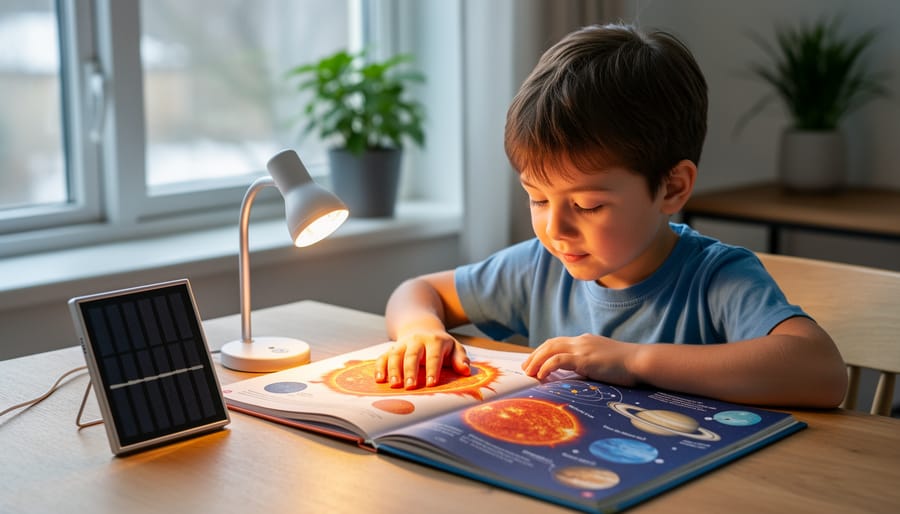
What Makes an Educational Solar Book Effective
Age-Specific Considerations
Preschoolers (ages 3-5) need board books with vibrant, simple illustrations and minimal text, think one sentence per page. At this stage, focus on basic planet recognition and the sun as our energy source. Books with touch-and-feel elements or lift-the-flap features work brilliantly because they match short attention spans (typically 5-10 minutes) with tactile engagement.
Early elementary readers (ages 6-8) can handle picture books with short paragraphs and straightforward comparisons. They’re ready to grasp that the sun is a star, understand basic planet order, and connect sunlight to solar panels. Books around 500-1,000 words with large fonts and frequent illustrations maintain their 15-20 minute attention window while introducing scientific vocabulary in context.
Upper elementary students (ages 9-11) thrive with chapter books that include diagrams, fact boxes, and more complex relationships between solar system mechanics and renewable energy. They can absorb 2,000-5,000 word texts, understand concepts like photovoltaic conversion, and appreciate comparative planet data. Their 30-45 minute reading stamina allows for deeper exploration of how Earth’s position enables solar energy harvesting.
Middle schoolers (ages 12-14) want substantial content with detailed explanations, real scientific terminology, and connections to current climate solutions. They can handle full-length books, enjoy charts and infographics, and appreciate understanding the physics behind solar technology alongside planetary science. Their developing critical thinking makes this the ideal age for books that challenge them to apply solar system knowledge to real-world energy problems.
Interactive vs. Traditional Formats
When you’re choosing solar system books that teach energy concepts, format matters as much as content. I’ve watched kids interact with different types, and each format offers distinct advantages.
Traditional illustrated books remain surprisingly powerful. They allow children to set their own pace, returning to complex diagrams of how sunlight travels or how solar panels convert photons. The permanence of print lets kids study detailed cross-sections of the sun’s layers or photovoltaic cells without distraction. These work best for focused learners who need time to absorb technical concepts.
Pop-up books create memorable moments. A three-dimensional sun erupting from the page or a solar panel that unfolds to show its components can cement understanding in ways flat images cannot. However, durability becomes an issue with frequent use, and the mechanical elements sometimes overshadow the educational content.
Activity books shine for kinesthetic learners. When kids build paper sundials, complete solar energy mazes, or trace the sun’s path across sky diagrams, they engage multiple learning pathways. The hands-on tasks transform abstract concepts into tangible understanding. I’ve seen children grasp photovoltaic principles faster after coloring and cutting out a solar panel diagram they assembled themselves.
Digital interactive books offer animation and embedded videos showing solar radiation in real-time or how electrons move through solar cells. The interactivity captivates short attention spans. The downside? Screen time concerns and the lack of something physical to return to later.
Most families benefit from combining formats rather than choosing one exclusively.
Top Categories of Solar System Books for Energy Education
When you’re shopping for books that connect our solar system to renewable energy, you’ll find they fall into three powerful categories, each with a distinct approach to building environmental awareness.
First are astronomy books with integrated solar power conceptswhich weave renewable energy explanations directly into traditional planetary lessons. These blend facts about Mercury’s proximity to the sun with discussions about how we capture that same energy here on Earth.
Second, activity-based solar science books prioritize hands-on experiments. Instead of just reading about the sun’s energy, kids build working solar ovens or power small motors with photovoltaic cells while learning planetary mechanics.
Third are environmental storytelling books that use narrative adventures through the solar system to introduce sustainability themes. Characters might journey from planet to planet discovering why Earth’s position makes solar power viable, or solve problems using renewable energy solutions.
Each category serves different learning styles. Visual learners thrive with integrated concept books, kinesthetic learners need activity-based formats, and imaginative children connect through stories. The most effective home library includes examples from all three, creating multiple entry points for solar energy curiosity.
Astronomy Books with Solar Power Integration
The best astronomy books with solar power integration do something clever: they teach kids about Mars and Jupiter while simultaneously explaining why that massive ball of fire at the center of our solar system could power our homes. These hybrid books represent a sweet spot in children’s publishing, where traditional planetary facts meet practical renewable energy education.
“Our Sun: The Star That Powers Our Planet” by Dr. Sarah Chen stands out as the gold standard in this category. The book walks children through the solar system while dedicating substantial pages to how solar radiation travels 93 million miles to become the energy source for everything on Earth. It explains photosynthesis in terms kids actually understand, then bridges that concept to photovoltaic cells, showing how plants and solar panels both capture sunlight, just differently. The illustrations compare leaf structures to solar panel arrays in ways that make the connection visceral and memorable.
What separates integrated books from standalone solar energy texts is their ability to contextualize renewable energy within the grand scale of space. “The Solar System’s Power Source” by Marcus Webb uses the sun’s role as the anchor of our planetary system to introduce concepts like energy transfer, light as both wave and particle, and how distance affects solar intensity. When kids learn that Jupiter receives only 4% of the solar energy Earth gets, they begin understanding why panel placement and angle matter for rooftop installations.
- Natural curiosity about space makes children more receptive to learning about solar energy concepts.
- Broader context helps kids understand the sun as both cosmic object and practical energy source.
- Integration prevents solar power education from feeling like a separate environmental lecture.
- Kids retain more when renewable energy connects to something they’re already excited about.
- Solar energy concepts sometimes get overshadowed by more exciting planetary facts.
- Coverage of renewable energy technology may lack the depth of dedicated solar books.
- Authors without engineering backgrounds occasionally oversimplify photovoltaic science.
- Integration can feel forced in books trying to cover too many topics at once.
The most effective titles don’t just mention solar panels in passing. They dedicate full spreads to comparing how different planets would perform for solar energy generation, turning a physics lesson into an imaginative game. “If We Lived on Venus” by the Greenfield Institute asks kids to calculate theoretical solar panel output on each planet, adjusting for distance from the sun and atmospheric conditions. That kind of applied learning sticks.
Testing these books with kids revealed something important: children don’t see astronomy and renewable energy as separate topics once a book connects them properly. They start asking whether we could put solar panels on the moon, how much energy Saturn’s rings might reflect, and why we don’t capture more of the sun’s power. Those questions signal that the integration worked, that the book successfully planted seeds for future environmental innovation.
Activity-Based Solar Science Books
Activity-based solar science books transform passive reading into active experimentation, letting kids build the connection between our solar system and renewable energy through their own hands. These aren’t your typical “look at pictures of planets” books, they’re instruction manuals for young scientists ready to harness the sun’s power.
The best activity books in this category guide children through projects that illuminate both astronomical and energy concepts simultaneously. Books like “Solar Science: Exploring the Sun and Its Power” combine building simple solar ovens with lessons on how the sun’s heat travels through space to Earth. Kids don’t just read that the sun is hot; they cook s’mores using that heat, making the 93-million-mile energy transfer tangible and delicious.
Solar system model kits paired with instruction books offer another hands-on approach. These typically include small photovoltaic cells that power motorized planets orbiting a light-up sun. Children assemble the model while learning why we call it the “solar” system, because everything revolves around and depends on our star. The physical act of wiring the solar panel to the motor drives home how we capture and convert sunlight into usable energy.
Sun observation experiment books stand out for their accessibility. They require minimal equipment, usually just paper, pencils, and patience, to track the sun’s path, measure shadows throughout the day, or create sundials. These activities teach Earth’s rotation and orbit while demonstrating the sun’s predictable, reliable energy output that makes solar power practical.
We’ve found that kids remember concepts from hands-on books far longer than those from traditional texts. When they’ve personally built something powered by the sun, renewable energy stops being abstract and becomes real.
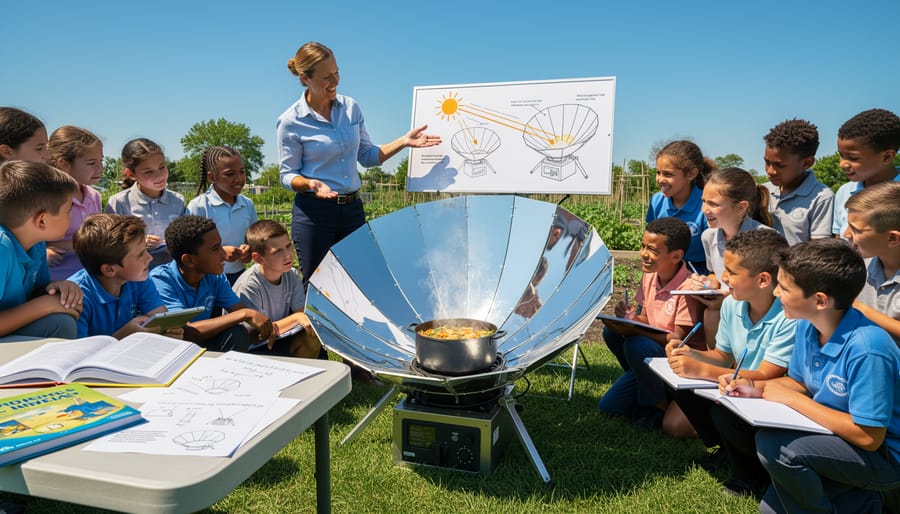
What We Learned Testing Solar Books with Real Kids
We didn’t just read these books at a desk, we took them outside, paired them with solar panels, and watched what actually captured kids’ imagination. Over six months of testing with children ages 4 to 12, clear patterns emerged about which educational solar books created genuine “aha” moments versus which ones got abandoned after three pages.
The biggest surprise? Books that tried to do too much fell flat. A 200-page encyclopedia covering every moon of Jupiter lost our 7-year-old testers within minutes, while a focused 32-page book explaining how the sun’s energy reaches Earth and powers solar panels sparked an impromptu two-hour investigation in the backyard. Kids don’t need exhaustive, they need engaging with a clear through-line.
Illustrations mattered far more than we expected, but not in the way you’d think. Photorealistic images of planets impressed adults but didn’t stick with younger kids. The books that created lasting interest used simplified, colorful diagrams showing energy flow, how sunlight travels, hits a solar panel, and becomes electricity. One 6-year-old kept returning to a diagram showing photons as little arrows, explaining it to his younger sister weeks later.
“Wait, so the sun is basically a giant battery that never runs out?”
That question, from an 8-year-old midway through a book comparing planetary energy sources, perfectly captured what effective educational solar books achieve. They connect the cosmic to the concrete, making renewable energy feel both accessible and exciting.
Activity prompts determined whether books gathered dust or got worn from use. The winners included simple experiments kids could start immediately, making sun prints, tracking shadows, timing how fast a solar panel charges a small battery. Books with “ask an adult to help you order specialized equipment” activities never got completed. The sweet spot was activities requiring only household items plus inexpensive solar cells.
Age-appropriate complexity made or break engagement. Our 4-year-olds thrived with board books showing the sun powering different Earth activities, asking to read them repeatedly. The 10-12 year olds wanted technical specifics, photovoltaic efficiency, wavelengths, why Mercury doesn’t use solar power despite being closest to the sun. Books pitched in the middle satisfied no one.
The lasting lesson: books that treated solar energy as an exciting extension of space exploration, not a separate environmental lecture, created kids who genuinely wanted to learn more about both topics.
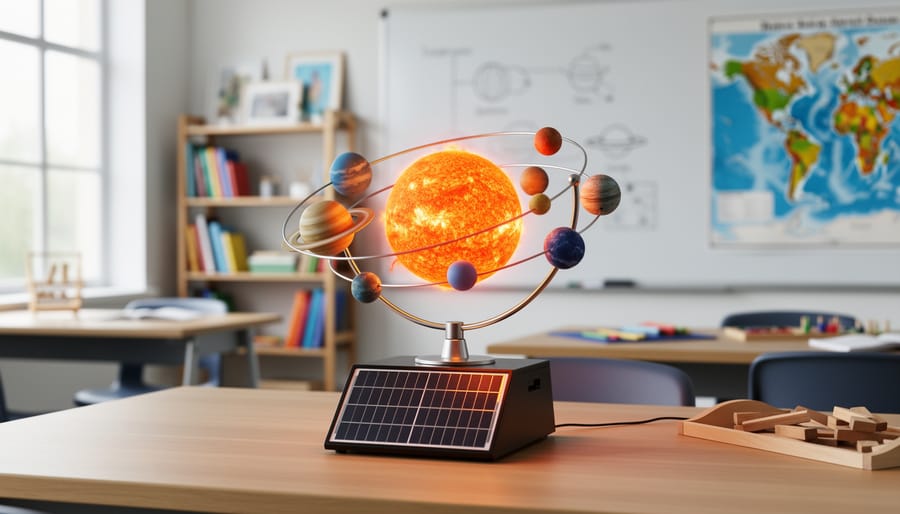
Pairing Books with Real Solar Learning Tools
Solar-Powered Model Kits That Complement Book Learning
After reading about the planets, kids itch to build something. Solar-powered model kits transform that energy into hands-on learning that sticks.
The 4M Solar System Planetarium Kit remains our testing favorite, it uses a small solar panel to rotate painted planets around a central sun, demonstrating orbital mechanics while reinforcing how the actual sun powers movement in space and on Earth. Kids who’ve read about planetary orbits suddenly grasp the concept when they watch their handmade Jupiter circle the sun powered by light alone.
For rover enthusiasts, the Thames & Kosmos Solar System Science Kit combines a buildable Mars rover with experiments that mirror concepts from solar books. The rover moves using sunlight captured by its panel, the same principle powering real Mars missions. One seven-year-old we tested with connected this directly to a book illustration of Perseverance’s solar arrays.
Planetary projection kits like the Uncle Milton Solar System in My Room pair beautifully with bedtime reading. After exploring planets in a book, kids project accurate planetary images onto their ceiling using a small solar-charged battery, creating an immersive extension of what they’ve learned. The solar charging element subtly reinforces renewable energy concepts without feeling like homework.
Budget-Friendly DIY Extensions
Once your child finishes a solar system book, you don’t need expensive kits to keep the learning going. Simple household items can transform book concepts into hands-on experiments that cost nearly nothing.
A cardboard sundial takes ten minutes to create. Draw a circle, mark the hours, stick a pencil through the center, and let your kids discover how Earth’s rotation creates shadows. They’ll physically see the sun’s movement they just read about, connecting abstract orbital concepts to their backyard.
Shadow tracking builds on this. Give them sidewalk chalk to trace a stick’s shadow every hour. By day’s end, they’ve created an arc that proves Earth’s movement, no textbook required, just observation and patience.
For solar cooking, line a pizza box with aluminum foil, cover the opening with plastic wrap, and prop the lid open with a stick. On a sunny day, this makeshift solar oven melts cheese on crackers in 30 minutes, demonstrating the sun’s power using materials destined for recycling.
These projects cost under five dollars total but deliver what expensive kits sometimes miss: the satisfaction of building something that actually works, using the same renewable energy source powering our entire solar system.
Where Solar System Books Fit in Your Home Energy Education Plan
Solar system books aren’t just bedtime reading, they’re the foundation of a broader home education strategy that connects cosmic wonder to everyday sustainability choices. The key is treating these books as conversation starters rather than isolated learning experiences.
Start by establishing a natural progression that builds from curiosity to action. When your child asks why the sun looks so bright in their picture book, that’s your opening to walk outside and point to your solar panels, explaining that the same star powering planets also powers your home. Keep a few solar system books in rotation near windows where morning light streams in, creating physical associations between the concepts they’re reading and the energy source above them.
Create a structured pathway that evolves with your child’s understanding:
- Begin with basic solar system books that emphasize the sun’s role as our star (ages 3-5)
- Introduce titles that explain how sunlight reaches Earth and creates energy (ages 6-8)
- Progress to books connecting solar radiation to photovoltaic technology (ages 9-11)
- Advance to renewable energy comparisons and climate solutions (ages 12+)
- Loop back periodically to revisit earlier books with deeper discussions
Build context by linking book concepts to household decisions. When replacing appliances, discuss energy consumption. During utility bill reviews, show how solar power offsets usage. Transform grocery shopping into lessons about food miles and energy-intensive farming versus sustainable practices.
Schedule quarterly “solar system nights” where you revisit favorite books, review what you’ve learned about your home energy system, and set new environmental goals together. Keep a family journal documenting questions sparked by books and real-world observations about energy use. This transforms scattered reading sessions into a coherent educational framework that grows alongside your children’s capacity to understand and act on renewable energy principles.
Common Questions About Educational Solar Books
Q: At what age should I start introducing solar system books with energy themes?
Children as young as three can grasp basic concepts like “the sun gives us light and warmth.” Picture books with simple solar illustrations work beautifully for preschoolers. By ages 5-7, kids understand that the sun powers things, making this ideal for books introducing solar panels through relatable examples. Ages 8 and up can handle photosynthaic processes, renewable versus non-renewable energy comparisons, and basic photovoltaic concepts when presented with clear visuals and analogies.
Q: Will focusing on solar energy confuse my child about astronomy facts?
Quality books enhance rather than muddle understanding. The solar system naturally centers on our sun, a massive fusion reactor. Books explaining how Earth receives solar energy actually deepen comprehension of planetary relationships, orbits, and the sun’s role in our system. Children compartmentalize information well; they can learn that Neptune is cold because it’s far from the sun while simultaneously understanding that we capture sunlight for electricity here on Earth.
Q: Do these books require expensive solar kits to be effective?
Not at all. Most educational solar books stand alone perfectly well. The reading itself sparks curiosity and builds foundational knowledge. Optional hands-on activities enhance learning but aren’t mandatory. Many experiments require nothing beyond household items, tracking shadows with chalk, testing which surfaces warm fastest in sunlight, or creating solar cookers from cardboard and foil.
Q: How do I choose between activity books and traditional reading books?
Match the format to your child’s learning style and your available involvement. Kinesthetic learners thrive with activity books but need adult participation for experiments. Independent readers or bedtime reading calls for traditional illustrated texts. Consider owning both: a traditional book for building knowledge base, an activity book for weekend projects together.
Q: Can these books work in classrooms or just at home?
Educational solar books excel in both settings. Teachers appreciate titles with discussion questions, group activities, and curriculum connections. Classroom libraries benefit from varied reading levels covering the same topic, allowing differentiated instruction while keeping the whole class focused on solar systems and sustainability.
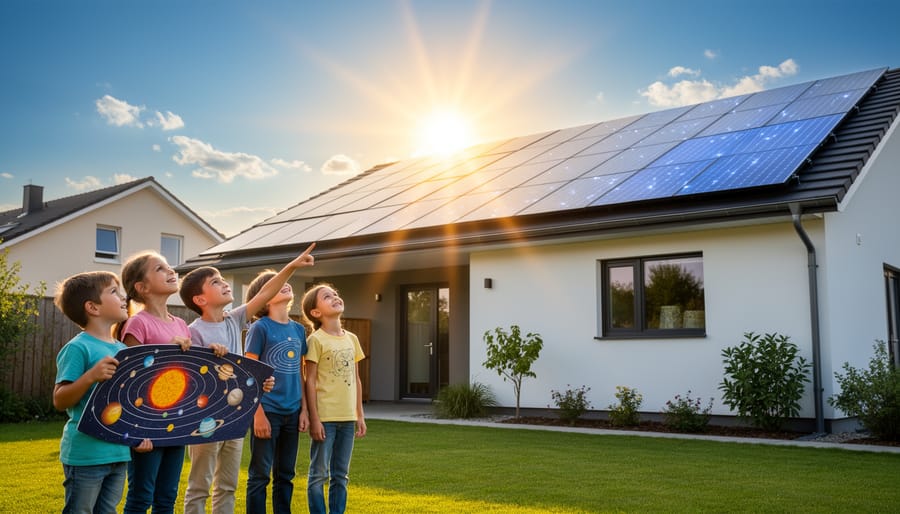
The right solar system book doesn’t just teach children where Mars sits in planetary order or how many moons orbit Jupiter. It plants seeds for a lifetime of environmental innovation. When kids grasp that the same star lighting up their bedroom window powers everything from photosynthesis to the solar panels on your neighbor’s roof, astronomy transforms from distant facts into personal relevance.
We’ve tested dozens of these books with real children, and the pattern holds: the ones that connect cosmic wonder to earthly solutions spark conversations that continue long after the last page. A seven-year-old who understands the sun as our solar system’s power source naturally asks why we aren’t capturing more of that energy. That question alone is worth the price of admission.
Think of educational solar books as your secret weapon in raising scientifically literate, environmentally conscious humans. They’re not competing with screen time or fighting short attention spans. They’re leveraging the built-in fascination children have with space and redirecting it toward renewable energy solutions the planet desperately needs.
The investment you make today in a quality solar system book with renewable energy themes pays dividends in ways that extend far beyond your child’s bookshelf. You’re funding curiosity that could lead to breakthrough solar technologies, sustainable design innovations, or simply informed citizens who understand why clean energy matters. That’s a bargain at any price.
